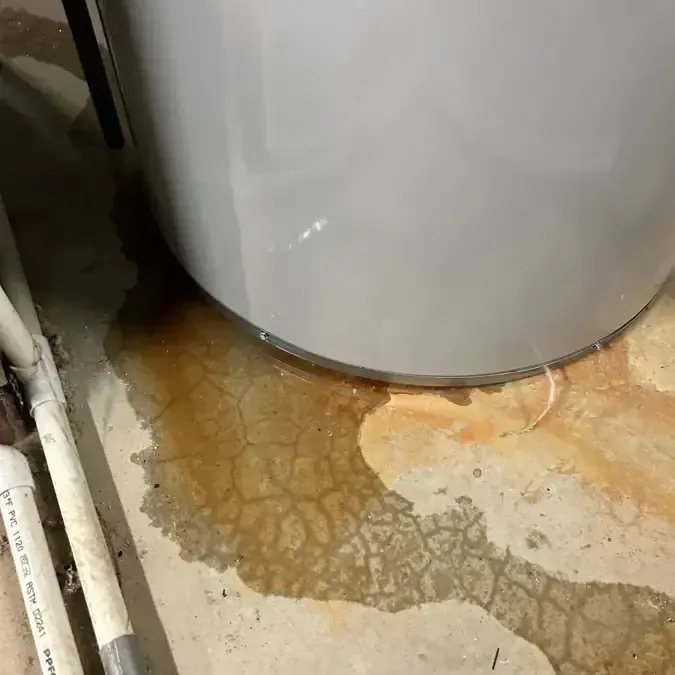
A water heater tank holds enough water to cover a garage floor and creep toward the house. When a tank fails, the next few steps decide whether the damage stays on the concrete or climbs into the walls.
Key takeaways
- Garage and closet tanks are common in postwar homes, and a failed tank can spread across a slab and reach drywall, cabinets and stored boxes.
- Shut the cold water supply to the tank, then turn off the power or gas before going near wet equipment.
- Move cardboard boxes, paper and fabric off the floor early, because they wick water upward.
- Extraction comes first, then the slab and wall bottoms are dried.
- A leaking tank is replaced rather than repaired, and the installer can answer questions about local requirements.
What a failed tank does to a garage
A tank water heater holds dozens of gallons. When a seam splits or the bottom corrodes through, that water has nowhere to go but across the floor.
Water follows the slope of the slab. It runs under shelves and workbenches, soaks the bottom of boxes and reaches the walls.
The city counted 10,816 housing units in 2020, and in postwar homes the heater often sits in the garage or a closet. Where the garage shares a wall with the house, water can reach the drywall and the door threshold into the home.
Even a slow leak matters. A weeping fitting can soak a wall bottom for weeks, and the first sign may be a musty smell, a warped baseboard or rust at the base of the tank.
The size of the tank, the way the water leaves it and how long it ran decide how far the damage goes.
Shutting things down safely
Electric and gas heaters carry different risks, and water makes both worse. Safety comes before saving anything.
A plumber should check the connections before the heater is turned back on, even if the leak seems to have stopped.
- Close the cold water shutoff on the pipe above the tank.
- Switch off power to an electric heater at the breaker, but only if the panel is dry and easy to reach.
- Turn a gas heater's control knob to off, and leave the area if there is any gas smell.
- Stay out of standing water near outlets, cords and the heater itself.
- Keep children and pets out of the garage until the water is gone.
Saving what is stored in the garage
Garages hold more than cars. Holiday boxes, tools, paperwork and spare furniture often sit on the floor, and they absorb water fast.
Items that are only damp can often be dried and kept. Anything that holds a smell or looks dirty after drying is better replaced.
- Lift cardboard boxes onto a dry workbench or a shelf above the wet area.
- Move paper, photos, books and fabric out first, since they are hardest to save once soaked.
- Leave heavy items on blocks rather than dragging them through the water.
- Photograph the damage before moving or discarding anything.
- Set aside anything that smells off or looks dirty for the insurer to see.
Common causes of a tank failure
Tanks fail for a handful of reasons, and knowing them helps decide what to check on a heater that is still working.
Older tanks fail more often, usually from corrosion that has worked from the inside for years, so a tank that is old deserves a look.
- Corrosion at the bottom of the tank, which often appears as rust stains or damp insulation.
- A relief valve that drips or discharges because pressure or temperature climbed.
- Loose or corroded supply and outlet connections at the top of the tank.
- A failed drain valve that weeps near the base.
- Sediment buildup that stresses the tank during heating.
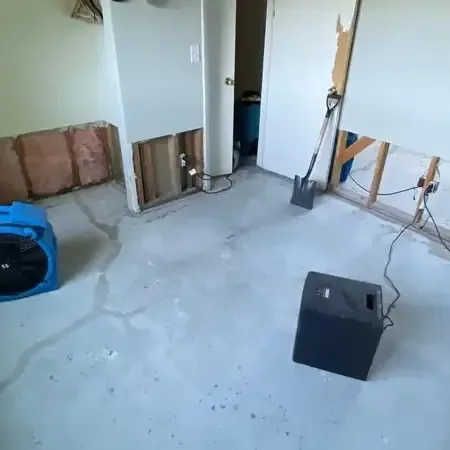
Extraction and drying on a slab floor
Extraction first
Truck mounted and portable units lift the standing water from the slab. The crew moves quickly, because water that sits begins to wick into drywall and cabinets.
This is the starting point for any water extraction job.
Drying the slab and wall bottoms
After extraction, LGR dehumidifiers and fans dry the concrete and the lower part of the walls. Moisture readings determine how long the equipment runs.
A slab dries slowly, so readings on each visit matter more than appearances. The standard approach to structural drying applies here.
Fans move air across the wet concrete while dehumidifiers pull the moisture out of the air, which keeps humidity in the house from rising.
On a slab, water also seeps into cracks and joints, so the concrete may stay damp longer than the surface suggests.
When the water reaches the house
Not every tank failure stays in the garage. Water can slip under the door into a hallway or laundry room, or wick up a shared wall.
Drywall that stays wet is cut back to dry material, and baseboards and flooring may need to be lifted. A hallway carpet next to the garage door is a common casualty.
The water heater leak cleanup work follows the water through every room it reached.
A heater in a closet inside the house is a different case. Water reaches the floor, the walls and sometimes the room below, so the opening and drying work covers more rooms.
Replacing the tank and keeping records
A leaking tank cannot be patched. It is replaced, and the installer can explain any local requirements for the new unit.
The installer can also say whether a drain pan makes sense for the space.
In the city, 54.8% of housing units were owner occupied and 45.2% rented in 2020. An owner arranges the replacement and the claim, while a renter should tell the landlord in writing at once.
Either way, keep photos, the cleanup records and the plumber's invoice together. Water from a similar failure can also come from other appliances, which is covered under appliance leak water damage.
Questions
Can a leaking water heater be repaired?
A tank that leaks from the shell or bottom is replaced. Small fixes such as a loose fitting or a relief valve may be repaired by a plumber.
Is water from a heater clean water?
It starts clean, but it picks up dirt from the floor and can be treated as contaminated if it sat. The restoration team judges this when inspecting the area.
How far can the water travel?
Across the slab, under doors and into shared walls. Moisture readings show how far it has gone.
Do stored boxes have to be thrown out?
Wet cardboard usually does, because it weakens and holds moisture. Contents in sealed plastic bins often survive.
Should a renter fix this alone?
No. A renter should shut off the water, photograph the damage and tell the landlord in writing so repairs and cleanup can be arranged.
Is it safe to run the water heater again?
Not until a plumber confirms the leak is fixed or the tank is replaced, and any wet electrical or gas components have been checked.