Structural Drying and Dehumidification in Rancho Cucamonga, CA
Structural drying pulls moisture out of framing, subfloor and drywall with air movers and dehumidifiers, and it is finished only when meter readings match a dry reference, not when the surface looks dry.
(888) 578-6508Start drying my wet structure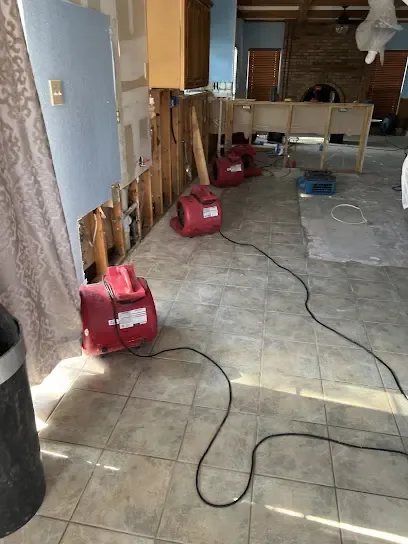
After the visible water is gone, the building still holds moisture in materials that look fine. Structural drying removes it on purpose, with equipment sized to the room and readings that show when the job is done. Skipping this step is how a small leak turns into swollen trim, buckled floors and a musty smell weeks later.
First steps for structural drying and dehumidification in Rancho Cucamonga
Remove the water
Extract standing water before drying begins.
Leave equipment on
Keep air movers and dehumidifiers running between visits.
Keep doors shut
Closed doors keep the drying air in the wet room.
Do not rebuild early
Wait for dry readings before closing walls or laying flooring.
How drying is planned
The crew classifies the loss by how much water the materials absorbed, then chooses the equipment and its placement from that, since a wet closet and a wet living room need very different setups.
- Class 1 and 2 jobs involve walls and pad
- Class 4 covers dense slab or hardwood
- Air movers are placed along wet walls
- Dehumidifiers pull moisture from the air
Water spreading while you read?
Surface water is only part of a water loss, so the crew dries the wood, drywall and subfloor behind it with controlled airflow and dehumidification, tracking meter readings at each visit.
Why readings matter
A surface can feel dry while the framing behind it is still wet, so meters set the pace. See the water extraction service for the step that comes before drying.
- Baseline readings from dry material
- Daily readings at each point
- Equipment moved as areas dry
- Release only at a dry reference
What speeds or slows the job
Dense materials, long-wet areas and sealed layers all take longer, while early removal of wet pad and trim shortens the process. Drying runs for as many days as the readings require, with no fixed schedule.
- Thick hardwood and subfloors dry slowly
- Carpet pad is removed to speed things up
- Closed wall cavities may need venting
- Containment keeps the air dry
Official reading: EPA indoor air quality basics and Energy Saver from the Department of Energy.
What does structural drying and dehumidification cost in Rancho Cucamonga, CA?
Structural drying in Rancho Cucamonga typically runs $1,000 to $6,000, depending on how many rooms are wet, the drying class and how dense the wet materials are. Concrete and hardwood sit at the high end.
- Air movers set
- One dehumidifier
- Daily readings
- More air movers
- Larger dehumidifier capacity
- Wall venting
- Specialty drying equipment
- Extended drying days
- Frequent readings
Ranges are typical, not a quote: water category, square footage, material class and how fast drying started move the number most.
Work out your own range on the cost calculator ›How structural drying and dehumidification is handled in Rancho Cucamonga
Every job starts with a moisture map, so the drying plan matches what is actually wet. Equipment stays until the readings say dry, not until the surface looks dry.
Classify
The loss class sets the equipment.
Place
Air movers and dehumidifiers go in.
Monitor
Readings are logged at each visit.
Release
Equipment leaves at a dry reference.
Structural drying and dehumidification across Rancho Cucamonga and nearby cities
Structural drying runs across Rancho Cucamonga, in homes from Alta Loma to Etiwanda and Terra Vista, and in commercial buildings near Haven Avenue, Milliken Avenue, Foothill Boulevard and the Victoria Gardens area, as well as Cucamonga and the Terra Vista Town Center shops.
The same service nearby: structural drying and dehumidification in Montclair, Upland, Ontario.
Water damage restoration in Rancho Cucamonga · every city covered
Structural Drying and Dehumidification questions in Rancho Cucamonga, CA
01What is structural drying?
It is the controlled removal of moisture from the building itself, using air movers and dehumidifiers, after the standing water has been extracted.
02Why does the equipment run for days?
Wood, drywall and subfloor release water slowly. The equipment keeps pulling moisture out until the meters show the materials are as dry as an unaffected sample.
03How is the equipment chosen?
By the size of the room and the materials involved. Larger or denser jobs need more air movers and a bigger dehumidifier than a small wet closet.
04Can a house dry on its own?
Not reliably. Opened windows and household fans rarely reach moisture trapped inside walls or under floors, which is why readings are taken.
05Does the dehumidifier raise the temperature?
Yes, rooms often feel warm and dry during the work. Keeping doors closed helps the equipment do its job faster.
06Is structural drying covered by insurance?
It is commonly covered as part of a sudden water loss. Daily logs and equipment records show what was dried. The burst pipe water damage service is one example.
Dry the structure, not just the surface
Moisture trapped in framing and subfloor keeps causing damage until it is dried. Call any hour and the drying team will plan the equipment.
(888) 578-6508Rancho Cucamonga drying help